
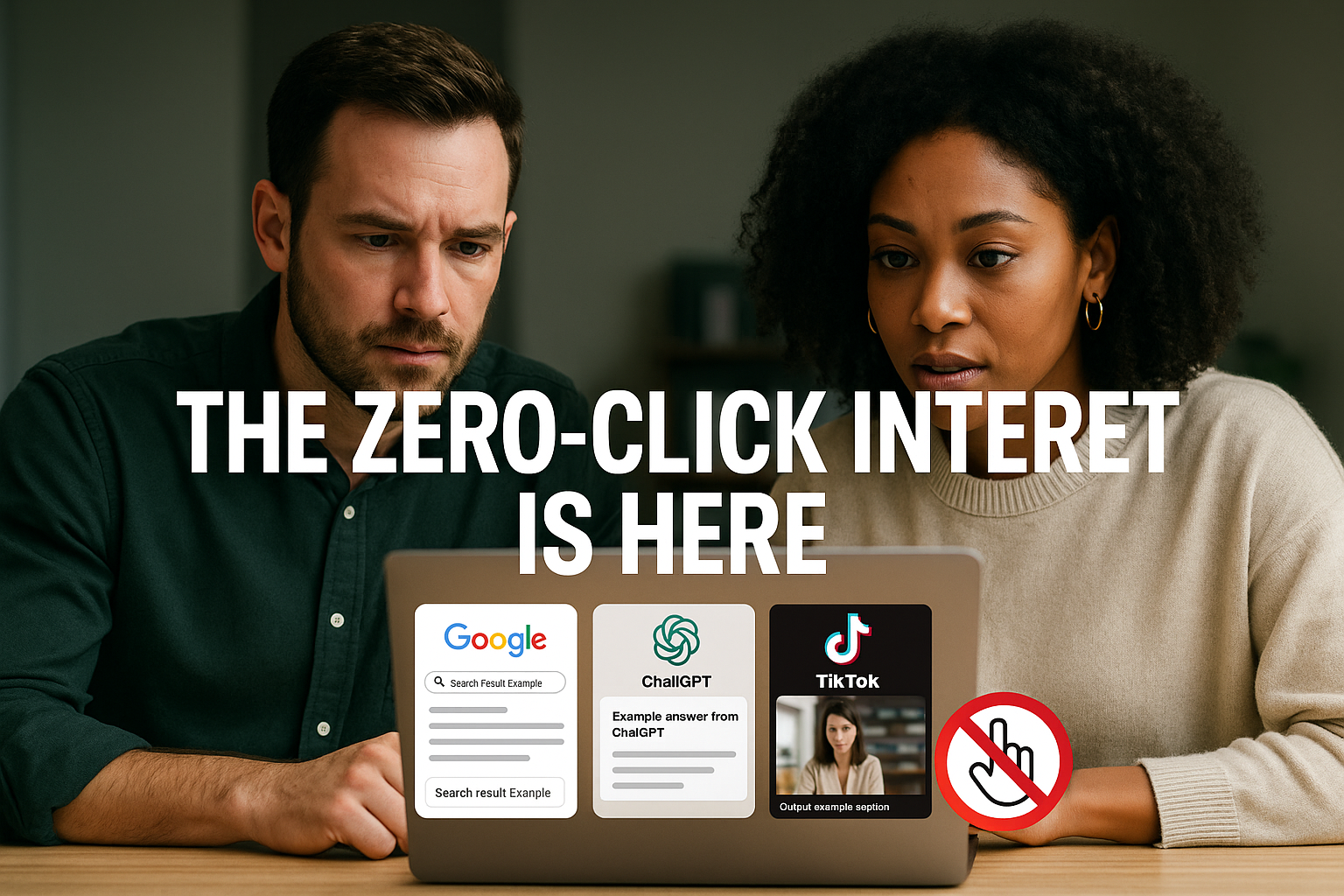
Because apparently, clicking is harder than finding a parking spot at Target on Black Friday
The Internet Just Got Lazier (And Smarter)
Picture this: You wake up, grab your phone, and ask Google “Why does my houseplant hate me?” Instead of clicking through seventeen gardening blogs that start with “Well, ACTUALLY, plants are complex organisms…” you get your answer right there on the search page.
Congratulations, you just experienced the Zero-Click Internet. And your houseplant? Still judging you, but at least now you know why.
The Zero-Click Internet isn’t some dystopian future—it’s happening right now. Search engines, AI tools, and social platforms are basically saying, “Why make people work for information when we can just… give it to them?”
Smart? Absolutely. Terrifying for content creators? Also absolutely.
But here’s the plot twist: You can still win this game. You just need to stop playing by the old rules.
What Exactly Is This Zero-Click Thing?
Let’s break it down without the tech jargon that makes your eyes glaze over.
The Zero-Click Internet is when platforms give users complete answers without requiring them to click through to your website. It’s like having a really efficient friend who reads everything and just tells you the good parts.
Here’s where it’s happening:
Google’s Getting Chatty: Featured snippets, “People Also Ask” boxes, and AI-generated overviews are basically mini-articles that live on the search page. Why click when Google just told you everything?
Social Media’s Going Full Wikipedia: TikTok tutorials that teach you to fold fitted sheets in 30 seconds. LinkedIn carousels that give you the entire marketing strategy. Instagram posts that solve your problems before you even know you had them.
AI Tools Are Content Vacuum Cleaners: ChatGPT will happily summarize your entire blog post, cite absolutely none of your sources, and send your potential readers on their merry way.
The internet basically said, “You know what? Friction is overrated.”

Should You Start Stress-Eating Cookies Now?
Only if they’re really good cookies. Otherwise, let’s think about this logically.
Yes, fewer people are clicking through to websites. But here’s what the panic-inducing headlines aren’t telling you: The right people are still clicking.
The Zero-Click Internet actually filters out the tire-kickers and leaves you with the people who genuinely want what you’re offering. It’s like having a bouncer for your content—only the serious folks get through.
Plus, consider this: Would you rather have 10,000 visitors who bounce after three seconds, or 1,000 visitors who actually care about what you have to say?
The Zero-Click world rewards creators who prioritize:
- Substance over clickbait (shocking, I know)
- Clear value over mysterious teasers
- Genuine expertise over keyword stuffing
If your content strategy was built on tricking people into clicking, then yes, you should probably panic. But if you’re actually helping people? You’re golden.
Your Zero-Click Survival Guide (AKA How to Win When Nobody Clicks)
1. Become Platform Native (Or Get Left Behind)
Every platform is basically a jealous ex—they want to keep users all to themselves. Fighting this is like trying to use a Nokia in an iPhone world.
Instead of forcing people to click away, deliver value right where they are:
- Instagram: Make carousels that teach, not tease
- LinkedIn: Write posts that solve problems in 300 words or less
- TikTok: Give the whole tutorial, not just the first step
- YouTube: Front-load your best advice in the first 30 seconds
The test: If someone can’t get value from your content without clicking, you’re doing it wrong.
2. Make Everything Screenshot-Worthy
In the Zero-Click world, screenshots are the new bookmarks. If people aren’t saving, sharing, or DM-ing your content, you’re not sticky enough.
What gets screenshot?
- Quote cards that make people look smart
- Step-by-step checklists they can follow
- Visual stats that make them say “I had no idea!”
- Infographics that explain complex topics simply
Pro tip: Create content that works as a standalone piece. Think of it like a good appetizer—it should be satisfying on its own, not just a preview of the main course.

3. Master Answer Engine Optimization (AEO)
SEO had a baby with AI, and it’s called Answer Engine Optimization. This is how you get featured in ChatGPT responses, Google’s AI overviews, and other answer engines.
The AEO playbook:
- Use conversational questions as headers: “Why does my conversion rate suck?” not “Conversion Rate Optimization Strategies”
- Structure answers clearly: Use bullet points, numbered lists, and short paragraphs
- Answer the question immediately: Don’t bury the lead in paragraph four
- Use natural language: Write like you’re explaining it to a friend, not a robot
Bonus: This approach also makes your content more readable for humans. Wild concept, right?
4. Build Your Own Digital Real Estate
Here’s the uncomfortable truth: You’re building your empire on someone else’s land. Instagram could disappear tomorrow. TikTok might get banned. Google could decide your website looks suspicious.
But you know what’s still here from the early internet days? Email.
Your insurance policy:
- Email list: Still converts better than any social platform
- SMS list: For when email feels too formal
- Private community: Discord, Slack, or your own forum
- Owned media: Your website, podcast, or newsletter
Think of social media as your marketing department, not your entire business model.
5. Be Unforgettable, Not Just Clickable
The goal isn’t to get a click—it’s to get remembered when it matters.
When someone sees your content, they should think “Oh, that’s the person who taught me about [your thing].” Not “Oh, that’s the person who tried to trick me into clicking.”
How to be memorable:
- Have a consistent voice: Funny, authoritative, conversational—pick one and stick with it
- Solve real problems: Not manufactured ones
- Share original insights: Not just recycled tips everyone already knows
- Be genuinely helpful: Even when there’s nothing in it for you

“But Should I Just Stop Blogging and Become a TikTok Star?”
Hold up there, future influencer. Blogging isn’t dead—it’s just evolving.
The blogs that are dying are the ones that read like they were written by committee in 2015. You know the ones: “In this comprehensive guide, we’ll explore the various methodologies and best practices for optimizing your content strategy…”
Insert snoring sounds here.
The blogs that are thriving:
- Get to the point immediately
- Use conversational language
- Include visuals that add value
- Answer questions people actually ask
- Don’t require a PhD to understand
Write like you’re texting a smart friend, not composing a thesis.
The Plot Twist: This Might Actually Be Better
Here’s something the doom-and-gloom articles won’t tell you: The Zero-Click Internet might actually improve the quality of content on the web.
When success isn’t measured purely by clicks, creators have to focus on:
- Actual value instead of curiosity gaps
- Real expertise instead of keyword stuffing
- Genuine helpfulness instead of clickbait tactics
- Clear communication instead of mysterious teasers
It’s like the internet is finally growing up and rewarding substance over style.
Your Zero-Click Action Plan
Ready to stop panicking and start adapting? Here’s your homework:
- Audit your current content: Does it provide value without requiring a click?
- Choose your platforms wisely: Pick 2-3 where your audience actually hangs out
- Start building your email list: Like, yesterday
- Create standalone value: Every post should solve a problem or teach something useful
- Track engagement, not just clicks: Saves, shares, and comments matter more than page views
The Bottom Line
The Zero-Click Internet isn’t the end of content creation—it’s the end of lazy content creation.
The creators who survive and thrive will be the ones who provide genuine value, build real relationships, and focus on being helpful rather than just being seen.
So stop optimizing for clicks and start optimizing for trust. Stop chasing traffic and start building an audience. Stop worrying about the algorithm and start focusing on the human being behind the screen.
The internet might be getting lazier, but your content strategy should be getting smarter.
Want more insights on thriving in the AI-driven content landscape? Subscribe to our newsletter for weekly tips that actually work in the real world.

by rrollins


Leave a comment