


Image via Archaeological Park of Pompeii
In the ancient ruins of Pompeii, a team of archaeologists recently unearthed a collection of 13 terracotta figurines, among them representations believed to capture the tragic love story of Cybele and Attis. The find sheds new light on the religious and cultural practices of this storied Roman city.
Standing approximately 15 centimeters (nearly six inches) tall, these figurines were found neatly aligned on what is believed to have been a shelf in a home’s hallway, presenting a remarkable glimpse into the private spiritual lives of its ancient inhabitants.
Among the collection are characters that are thought to represent the tragic mythological tale of the goddess Cybele and her lover, Attis. The location of these figures, found over two meters (6.56 feet) above the floor level amid wall decorations and frescoes, indicates their significance in the domestic setting, likely as objects of veneration or as part of household religious rituals.
The sculptures of about 15 cm in height among which one can recognise human figures, but also a walnut, an almond, the head of a rooster in clay and a glass pine cone were found in a room in an upright position on a horizontal plane where a shelf was probably affixed. pic.twitter.com/8Kvd9qqzzW
— Pompeii Sites (@pompeii_sites) December 22, 2023
Cybele, known as the Great Mother or Mother of the Gods, is a symbol of nature’s untamed and fertile force. She is often depicted in association with wild animals, mountains, and robust natural scenery. Her consort, Attis, represents a young deity of vegetation, particularly the evergreen pine tree, embodying the cycle of life, death, and rebirth that was central to ancient fertility cults.
The myth narrates Cybele’s deep love for Attis, which turns to despair when Attis is unfaithful or attempts to marry a mortal. In a fit of rage and jealousy, Cybele drives Attis to madness, leading to his self-mutilation and death under a pine tree. Following his demise, Cybele, in a state of remorse, implores Zeus to grant Attis immortality, allowing his body to never decay. This dramatic tale captures themes of love, betrayal, and the cyclical nature of life, which resonated deeply in the Roman world.
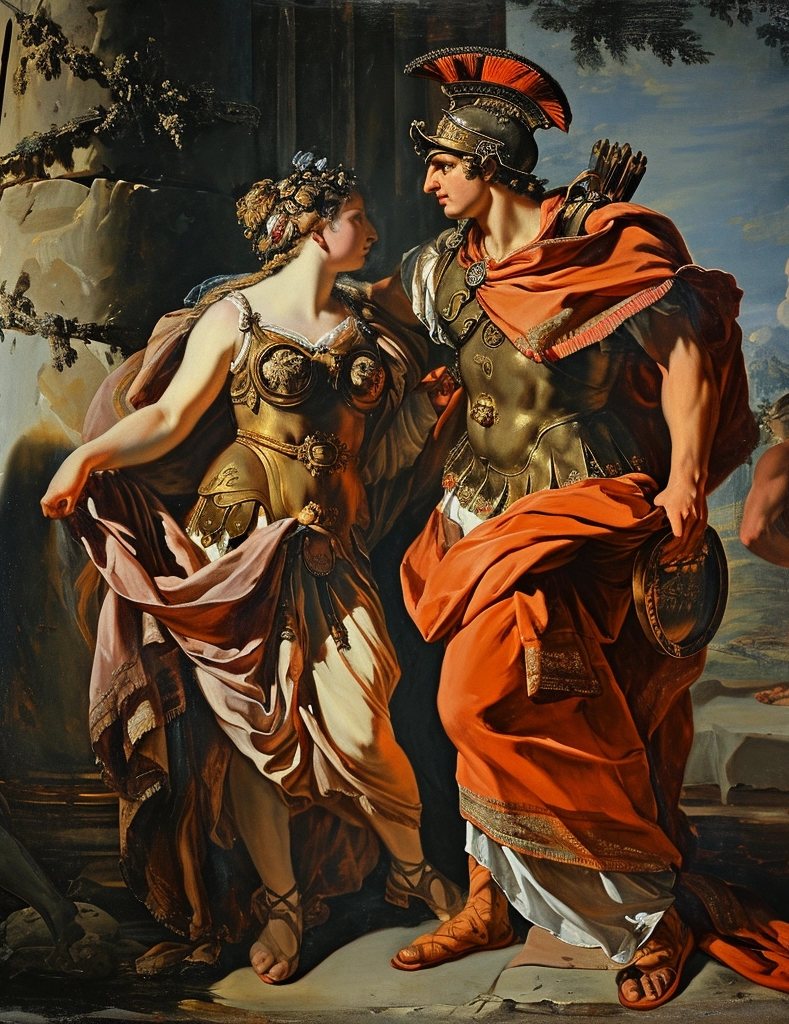
Image depicting Cybele and Attis, generated on AI
These terracotta figurines, likely part of the home’s decorative and religious fabric, illustrate the importance of the Cybele-Attis lore in Roman domestic worship and the broader religious landscape of the time. Its themes of resurrection and fertility were particularly pertinent to ancient fertility cults and rituals, especially during the spring equinox, symbolizing the eternal cycle of growth, decay, and rebirth.
Other sculptures in the mix portray a cockerel’s head, an almond, a walnut, and a pine cone.
From initial studies, some of the figurines seem to refer to the myth of Cybele and Attis, connected to the life cycle of the seasons and the fertility of the earth, and thus to the spring equinox. pic.twitter.com/3wH2cYtMf6
— Pompeii Sites (@pompeii_sites) December 22, 2023
The recovery of these figurines near the House of Leda and the Swan, named after a sensual fresco found in 2019, suggests the homeowner’s cultural affluence and desire to surround themselves with mythologically inspired art.
The ongoing efforts in Pompeii are not just about uncovering the past; they’re also crucial in preserving these treasures for future generations and making them accessible for public learning and appreciation.
As the excavation and restoration work continues in the area, each new finding, like these terracotta figures, adds another piece to the puzzle of understanding daily life in the ancient city before its catastrophic end.
[via IFLScience, The Archaeologist, The Guardian, images via various sources]

by rrollins

Recent Comments